
The NBA, a league of towering athletes and high-stakes drama, is governed by a complex set of rules, and technical fouls are a significant part of the game. These infractions, often stemming from displays of frustration or unsportsmanlike conduct, carry weight far beyond the immediate penalty. They can influence a player’s availability, team strategy, and even the outcome of a game.
Understanding the threshold for technical fouls and the resulting suspensions is crucial for fans, players, and coaches alike. This piece dissects the intricacies of the NBA’s technical foul regulations, exploring their impact on player performance, team dynamics, and the role of officials in enforcing these critical rules. We’ll examine the evolution of these rules, the distinctions between technical and flagrant fouls, and the strategies teams employ to navigate this nuanced aspect of the game.
Understanding the NBA’s Rules Regarding Technical Fouls and Player Suspensions in Professional Basketball
The National Basketball Association (NBA) maintains a strict set of rules governing player conduct on and off the court. These rules are crucial for maintaining the integrity of the game and ensuring fair play. A significant aspect of these regulations concerns technical fouls, which can lead to suspensions and impact a team’s performance. Understanding these rules is vital for players, coaches, and fans alike.
Technical fouls in the NBA are assessed for various infractions, ranging from unsportsmanlike conduct to violations of game rules. Each technical foul carries a penalty, and the accumulation of these fouls can result in suspensions. The NBA rulebook clearly Artikels the specific thresholds that trigger suspensions, both during the regular season and the playoffs. These rules are designed to discourage negative behavior and maintain a professional environment within the league. Players are responsible for adhering to these guidelines, and failure to do so can result in significant penalties. The consequences of technical fouls can range from financial fines to missing crucial games, impacting both individual careers and team success.
Technical Foul Accumulation and Suspension Thresholds
The NBA’s policy on technical fouls and suspensions differs slightly between the regular season and the playoffs. This section details the accumulation thresholds that lead to automatic suspensions for players.
The following points summarize the technical foul accumulation thresholds that trigger automatic suspensions:
- Regular Season: A player receives an automatic one-game suspension for their 16th technical foul. Further suspensions occur for every two technical fouls accumulated after the 16th (e.g., 18th, 20th, etc.).
- Playoffs: The rules are adjusted for the playoffs. A player is suspended for one game upon receiving their 7th technical foul during the playoffs. Additional suspensions occur for every technical foul thereafter.
Types of Actions Resulting in Technical Fouls
Technical fouls are assessed for a variety of actions that violate the NBA’s rules. These infractions cover a wide range of behaviors, from on-court conduct to interactions with referees. Here is a breakdown of common actions that result in technical fouls, along with examples and rule references.
| Type of Action | Description | Example | NBA Rule Reference |
|---|---|---|---|
| Unsportsmanlike Conduct | Actions deemed disrespectful or inappropriate, including taunting, excessive gesturing, or arguing with officials. | A player taunts an opponent after a successful basket, making gestures towards the opposing bench. | Rule 12, Section I |
| Excessive Contact | Unnecessary or excessive contact with an opponent. | A player throws an elbow during a rebound attempt, making contact with an opponent’s head. | Rule 12, Section II |
| Delay of Game | Actions that intentionally delay the game’s progress. | A player deliberately kicks the ball out of bounds after a whistle to waste time. | Rule 12, Section III |
| Profanity or Offensive Gestures | Use of offensive language or gestures towards officials, opponents, or fans. | A player uses profane language directed at a referee after a call. | Rule 12, Section IV |
| Fighting | Any physical altercation between players. | Two players engage in a fistfight after a hard foul. | Rule 12, Section V |
| Illegal Use of Hands | Using hands to impede an opponent’s progress. | A defender repeatedly slaps the arms of the player with the ball to try to steal it. | Rule 12, Section VI |
Examining the Differences Between Technical Fouls and Flagrant Fouls in the Context of NBA Play

The NBA, renowned for its athleticism and competitive spirit, maintains a strict code of conduct on the court. This code is enforced through a system of penalties, primarily involving technical and flagrant fouls. While both disrupt the game and can lead to player suspensions, they differ significantly in their nature and the severity of their consequences. Understanding these distinctions is crucial for both players and fans alike, as they directly impact game flow and player availability.
Distinguishing Technical and Flagrant Fouls
Technical fouls and flagrant fouls represent distinct violations of NBA rules. Technical fouls generally address unsportsmanlike conduct, such as excessive complaining, taunting, or delaying the game. Flagrant fouls, on the other hand, are reserved for excessive or unnecessary contact against an opponent.
Technical fouls often arise from verbal altercations with referees, disrespectful actions towards opponents, or deliberate attempts to disrupt the game’s pace. Examples include arguing calls, using abusive language, or hanging on the rim after a dunk. These infractions are penalized with a free throw for the opposing team and, if accumulated, can lead to suspensions.
Flagrant fouls, however, involve physical contact deemed excessive or dangerous. They are categorized into two types: Flagrant 1 and Flagrant 2. A Flagrant 1 foul involves unnecessary contact, while a Flagrant 2 foul signifies unnecessary and excessive contact, often with the potential for injury. Examples include a hard foul that is not directly related to playing the ball or a malicious elbow to the head. The severity of a flagrant foul dictates the penalties imposed, with Flagrant 2 fouls carrying harsher repercussions.
Comparing Penalties for Technical and Flagrant Fouls
The penalties for technical and flagrant fouls vary considerably, reflecting the different nature of the infractions. Understanding these differences is vital for appreciating the rules and their impact on player conduct and team strategies.
- Technical Fouls:
- Result in one free throw for the opposing team.
- Players are ejected from the game after accumulating two technical fouls in a single game.
- Accumulating a certain number of technical fouls throughout the season leads to automatic suspensions. For example, a player might face a one-game suspension after reaching 16 technical fouls, with escalating suspensions for subsequent accumulations.
- Fines are often associated with technical fouls, with amounts increasing based on the number of infractions.
- Flagrant Fouls:
- Flagrant 1 fouls result in two free throws for the opposing team and the player who committed the foul remains in the game.
- Flagrant 2 fouls result in two free throws for the opposing team and immediate ejection from the game.
- Flagrant fouls carry automatic suspensions, depending on the severity and frequency of the fouls. A player receiving a Flagrant 2 foul is automatically suspended for at least one game.
- The NBA can review flagrant fouls and potentially increase the penalty, including additional suspensions and fines.
- Fines are typically higher for flagrant fouls than for technical fouls, especially for Flagrant 2s.
The NBA’s Flagrant Foul Review Process
The NBA employs a comprehensive review process to determine the severity of flagrant fouls and to ensure fair application of the rules. This process involves multiple parties and considers various factors to arrive at a final determination.
The review process for flagrant fouls in the NBA involves the following steps:
- On-Court Determination: Referees on the court initially assess the foul and determine whether it is a Flagrant 1 or Flagrant 2. This is based on their immediate observation of the contact.
- League Review: The NBA’s league office, specifically the NBA Replay Center in Secaucus, New Jersey, reviews all flagrant fouls, using video replays from multiple angles.
- Determination Committee: A panel of officials, including league representatives and sometimes former players or referees, reviews the play. They assess the nature and severity of the contact, considering factors such as the force of the contact, the location of the contact, and whether the contact was deemed unnecessary or excessive.
- Decision and Penalties: The committee can uphold the original call, downgrade a Flagrant 2 to a Flagrant 1, or upgrade a Flagrant 1 to a Flagrant 2. They also determine any associated penalties, including suspensions and fines. These decisions are then communicated to the team and the player.
- Appeal Process: While rare, teams or players may have limited avenues for appeal, though the league’s initial determination typically stands.
Exploring the Historical Evolution of Technical Foul Regulations in the National Basketball Association
The National Basketball Association’s (NBA) rules regarding technical fouls and subsequent player suspensions have undergone significant transformations since the league’s inception. These changes reflect the league’s ongoing efforts to balance player conduct, game integrity, and fan entertainment. Early iterations of the rules were far less stringent, but as the game evolved, so did the need for stricter guidelines to maintain order and professionalism on the court. The evolution of these regulations provides insight into the league’s values and its adaptation to changing player behavior and the evolving demands of a global audience.
Significant Modifications in Technical Foul Regulations
The NBA’s approach to technical fouls and suspensions has been refined over the years, responding to specific incidents, shifts in player behavior, and the desire to improve the overall game experience. The primary drivers behind these modifications include curbing excessive displays of emotion, preventing unsportsmanlike conduct, and ensuring fair play. The league has consistently sought to discourage actions that could undermine the integrity of the game or detract from its entertainment value. These modifications demonstrate the NBA’s commitment to creating a competitive yet controlled environment.
Timeline of Key Rule Changes
The following timeline details key rule changes related to technical fouls, highlighting the dates and specific modifications implemented:
- 1946 (NBA Founding): Initial rules established with limited definition of technical fouls, primarily addressing unsportsmanlike conduct. Suspension thresholds were relatively high, with suspensions occurring after multiple technical fouls.
- 1960s-1970s: As player conduct became more demonstrative, the league began to refine the definition of technical fouls to include taunting, excessive arguing, and other disruptive behaviors.
- 1980s: The NBA implemented stricter enforcement of technical fouls and introduced escalating penalties, including fines and suspensions, to deter misconduct. This period saw increased attention to player behavior and its impact on the game.
- 1990s: Following the increased physicality and competitive intensity of the era, the NBA further clarified rules to penalize specific actions, such as excessive celebrations and flagrant fouls.
- 2000s-Present: The league continues to refine its rules, adjusting suspension thresholds and emphasizing the importance of sportsmanship. The introduction of instant replay also influenced how technical fouls are assessed, leading to more accurate calls and stricter enforcement.
Visual Representation of the Evolution
A detailed illustration depicts the evolution of technical foul regulations over time, visualizing the different phases and their impact on player behavior and game dynamics. The illustration uses a series of interconnected circles to represent each decade, with each circle containing key elements.
The first circle, representing the 1940s-1950s, is relatively small, showing a simple depiction of a basketball court and a few stick figures representing players. Inside, there’s a symbol of a referee’s whistle and a faint depiction of a technical foul with a low penalty. This signifies the initial, less-defined rules and lower penalties.
The next circle, for the 1960s-1970s, is larger, with more detailed player figures and a clearer referee symbol. The technical foul symbol is more pronounced, and a rising arrow indicates increasing penalties. This reflects the increased emphasis on player conduct.
The 1980s circle is even larger, showing players with more aggressive poses, and a more prominent referee symbol with a magnifying glass. The technical foul symbol is now accompanied by a dollar sign and a suspension icon, highlighting the introduction of fines and suspensions.
The 1990s circle shows a dynamic basketball court, with players celebrating and arguing. The referee symbol is more complex, with multiple whistles and hand signals. The technical foul symbol is accompanied by a flagrant foul symbol, emphasizing the stricter enforcement of rules.
The final circle, representing the 2000s to the present, is the largest, with a detailed court, diverse player representations, and a complex referee symbol with a replay monitor. The technical foul symbol is integrated with a sophisticated penalty system, showing escalating penalties, including game suspensions. This illustrates the modern era’s emphasis on precision and sportsmanship. Connecting lines between the circles show the evolution and interconnectedness of the rules over time.
Analyzing the Impact of Technical Fouls on Player Performance and Team Strategy During Games
Technical fouls, often the result of unsportsmanlike conduct or disagreements with officials, represent a significant disruption in the flow and strategic execution of an NBA game. Beyond the immediate penalty of a free throw for the opposing team, technical fouls carry a ripple effect, impacting player psychology, team dynamics, and coaching decisions.
Effects on Player Performance, Team Dynamics, and Coaching Strategies
A technical foul can significantly alter a player’s performance. The immediate impact is the loss of concentration and an increased risk of further fouls. Players may become more hesitant, playing less aggressively to avoid another technical or a flagrant foul that could lead to ejection. This hesitancy can negatively affect offensive production, rebounding, and defensive intensity. The opposing team often capitalizes on this vulnerability, targeting the player on offense and defense.
Team dynamics also suffer. A technical foul can create tension within the team, especially if the infraction was perceived as unnecessary or detrimental. Teammates may become more cautious in their interactions with the player, and trust can erode if the behavior becomes a recurring issue. The coach’s response to the technical foul further shapes team dynamics. If the coach publicly criticizes the player, it can lead to resentment and decreased morale. Conversely, a supportive approach, while acknowledging the error, can help maintain team cohesion.
Coaching strategies are forced to adapt. Coaches must decide whether to bench the player, risk further technical fouls, or adjust the team’s game plan to compensate for the player’s limitations. They may alter substitution patterns, shift defensive assignments, or modify offensive sets to minimize the impact of the player’s technical foul. The coach’s ability to effectively manage these situations can determine the outcome of the game. A coach who fails to address the issue appropriately risks a cascade of negative consequences that could lead to the loss of a game.
Coaching Strategies for Managing Players Prone to Technical Fouls
Coaches employ various strategies to manage players prone to technical fouls, aiming to prevent these infractions and mitigate their impact.
- Pre-Game Communication: Before each game, coaches often discuss expectations with players known to be susceptible to technical fouls. They reiterate the importance of controlling emotions, respecting officials, and focusing on the game plan.
- In-Game Reminders: During timeouts or breaks in play, coaches may provide gentle reminders to players about their behavior. This can involve specific instructions, such as “Stay away from the officials,” or “Control your reactions.”
- Substitution Management: Coaches strategically use substitutions to manage players at risk of accumulating technical fouls. If a player is showing signs of frustration or is involved in a contentious situation, the coach might substitute them to cool them down.
- Verbal and Non-Verbal Cues: Coaches develop signals to communicate with players during the game. This could involve hand gestures or specific phrases to indicate that a player needs to calm down or back off from a confrontation.
- Film Review and Feedback: After games, coaches often review game film with players to identify instances where they could have avoided technical fouls. This feedback is critical for self-awareness and behavioral adjustments.
- Building Trust and Rapport: Coaches who foster strong relationships with their players often find it easier to manage their emotions and behaviors. Players are more likely to listen to and respect a coach they trust.
- Penalty System and Accountability: Some teams implement internal penalty systems for technical fouls, such as fines or reduced playing time. This approach reinforces accountability and encourages players to be more mindful of their actions.
Example: A Player’s Technical Foul and Its Game Impact
Consider a scenario involving a star point guard, let’s call him “Marcus,” known for his competitive fire and tendency to argue with referees. Early in the third quarter, with the score close, Marcus receives a technical foul for arguing a charging call. The impact unfolds as follows:
Player Behavior: Marcus’s frustration mounts. He becomes less assertive on offense, hesitant to drive to the basket, fearing a foul call. Defensively, he is more tentative, allowing his opponent to drive past him more easily.
Coach’s Reaction: The coach calls a timeout to address the situation. He pulls Marcus aside and calmly reminds him to focus on playing and to avoid further confrontations. He emphasizes the importance of remaining on the court and contributing positively to the team. The coach also subtly adjusts the offensive strategy, incorporating more off-ball screens to get Marcus easier scoring opportunities and reduce his need to create his own shots.
Team Strategy Change: The team’s overall strategy shifts. The coach starts giving more minutes to the backup point guard, to lessen the burden on Marcus. The team emphasizes ball movement and tries to establish a strong inside presence to draw fouls and take pressure off Marcus. The other players are more careful to avoid unnecessary fouls to ensure they remain on the court. The team’s overall energy and focus decrease. The opposing team recognizes the change in Marcus’s behavior and the team’s reaction, which leads to a shift in their defensive strategy. They put more pressure on Marcus and try to draw him into further frustration. This scenario demonstrates how a single technical foul can cascade into a series of strategic adjustments and psychological shifts, potentially altering the game’s outcome.
Investigating the Role of Officials in Awarding Technical Fouls and the Consistency of Enforcement
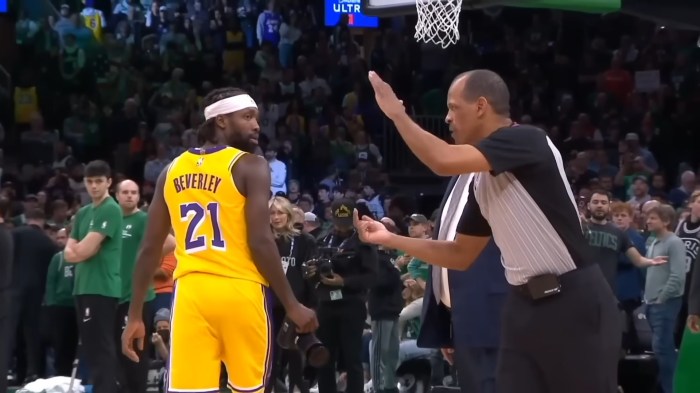
NBA officials play a critical role in maintaining order and ensuring fair play. Their decisions, particularly regarding technical fouls, directly impact game flow, player behavior, and ultimately, the outcome of the game. However, the subjective nature of some infractions and the high-pressure environment can lead to inconsistent calls, sparking controversy and raising questions about the standards of enforcement.
Criteria for Assessing Technical Fouls
Officials rely on a specific set of criteria when determining whether a player’s action warrants a technical foul. These criteria are designed to address unsportsmanlike conduct and actions that disrupt the game’s integrity.
- Excessive Contact or Physicality: This includes unnecessary roughness, flagrant fouls, and actions deemed excessively aggressive. For example, a hard foul that is deemed intentional, even if it doesn’t result in an injury, could warrant a technical.
- Verbal Abuse or Profanity: Officials penalize players who use abusive language towards referees, opponents, or fans. This includes cursing, threats, or any form of disrespectful communication.
- Taunting or Trash Talking: This covers actions designed to provoke opponents or draw attention to oneself in a disrespectful manner. This can include excessive celebrations after a basket, staring down an opponent after a block, or making gestures that are considered offensive.
- Delay of Game: Players or coaches who intentionally delay the game, such as by failing to inbound the ball quickly or arguing excessively with officials, can receive technical fouls.
- Unsportsmanlike Conduct on the Bench: This covers bench personnel who engage in inappropriate behavior, such as leaving the bench during a fight or verbally abusing officials.
- Use of Illegal Equipment: Players using equipment that violates league rules, such as visible undershirts or tape that is not permitted, can also receive technical fouls.
Hypothetical Controversial Technical Foul Call
Consider a scenario during a close playoff game between the Los Angeles Lakers and the Boston Celtics. The score is tied with 30 seconds remaining in the fourth quarter. LeBron James drives to the basket, draws a foul, and makes the basket. The referee blows the whistle, signaling the foul and points, and James begins to celebrate. He flexes his muscles and yells towards the Celtics bench. The referee immediately calls a technical foul on James for taunting.
The NBA rulebook states that technical fouls can be issued for “using language or gestures that are considered offensive or inflammatory.”
The call is immediately met with protests from the Lakers’ coaching staff and James himself. They argue that his celebration was within acceptable bounds, and that the referee’s call was too quick and potentially game-altering. The Celtics, on the other hand, support the call, believing James’ actions were excessive and intended to taunt their team.
The officials’ decision-making process in this situation would likely involve several factors:
- Severity of the Gesture: The referee would assess the nature of James’ celebration. Was it overly aggressive or provocative?
- Intent: Did James intend to taunt the Celtics or was it simply an expression of excitement?
- Game Context: The high-pressure environment of a close playoff game could influence the officials’ perception of the action.
- Consistency: The referee would consider whether similar actions by other players earlier in the game had been penalized.
The potential for debate is significant. Some analysts might argue the call was justified, citing the need to maintain decorum and prevent excessive celebrations. Others might criticize the call, suggesting it was overly sensitive and that the referee should have allowed the excitement of the moment. The impact on the game is immediate: The Celtics get a free throw, and possession of the ball, potentially shifting the momentum and outcome of the game. This situation highlights the subjective nature of technical foul calls and the challenges officials face in ensuring consistent enforcement of the rules, particularly under pressure.
Final Wrap-Up

In conclusion, the NBA’s rules on technical fouls and suspensions are a dynamic element of the sport, shaping player behavior and game strategy. From the specific accumulation thresholds to the role of officials in their enforcement, these regulations play a vital role in maintaining the integrity and competitiveness of the league. As the game evolves, so too will these rules, ensuring that the balance between competition and sportsmanship remains at the forefront of the NBA’s enduring legacy.
